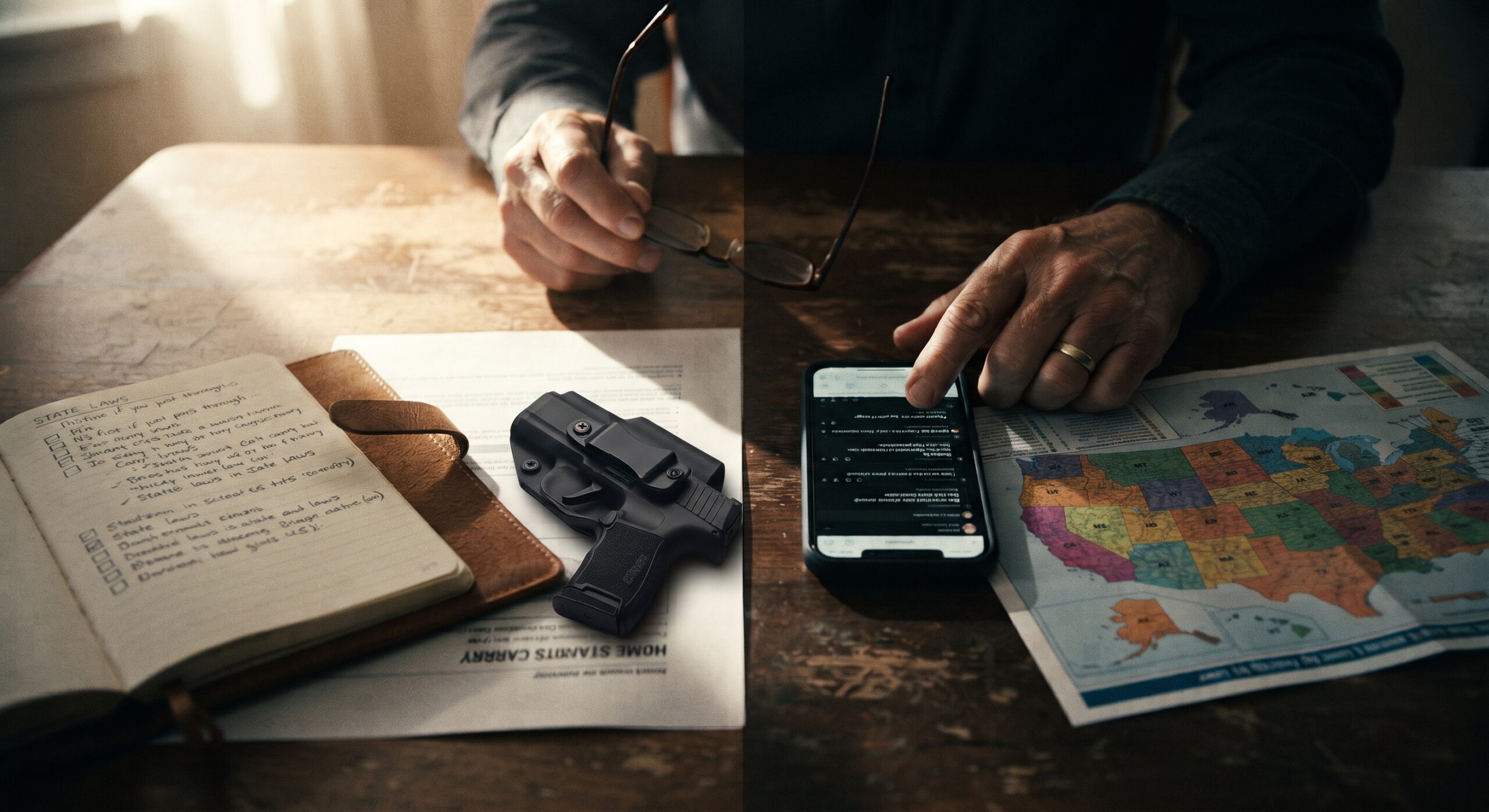
You’re packing for a weekend at your brother’s house. Overnight bag, phone charger, something to keep the kids occupied in the car. You reach for the handgun you carry every day.
Then your spouse asks a question you should have answered earlier.
“Can you carry that where we’re going?”
You know the rules at home. Your state doesn’t require a permit, and you’ve been carrying legally for months. But your brother lives across the state line. You’re also driving through another state to get there.
You open your phone. One website says your home state’s permit is recognized. Another talks about permitless carry. Someone in a discussion forum insists you’re fine as long as the gun stays in the car.
You don’t have a permit. You’re supposed to leave in twenty minutes.
That uncertainty is a useful starting point for deciding whether to get one. Your state removed a requirement. It didn’t necessarily remove every reason to hold the license.
A carry permit may expand your travel options, provide benefits at home, or simplify certain firearm purchases. Whether those benefits justify the expense depends on how you live.
Work through the following questions with your calendar and a few official websites open. By the end, you should be able to explain exactly what a permit would do for you.
Know What Permitless Carry Actually Allows
Start with your home state’s current rules.
“Constitutional carry” generally describes laws allowing eligible people to carry a firearm without obtaining a carry permit first. The details vary. Don’t assume the phrase answers questions about concealed versus open carry, age, eligibility, or particular locations.
Also distinguish being allowed to own a firearm from being allowed to carry it in a particular way or place.
The Texas State Law Library illustrates why this matters. Its permitless-carry guidance identifies eligibility restrictions and explains that restrictions on locations and private property remain. Removing the licensing requirement did not remove the rest of the law. sll.texas.gov
Find the official carry guidance published by your state police, public safety department, attorney general, or other responsible agency. Follow its links to the relevant statutes when you need more detail.
Write down the answers to four questions:
- Am I eligible to carry without a permit?
- Does that apply to the way I intend to carry?
- Which locations and activities remain restricted?
- What requirements apply when I carry in a vehicle?
Keep a link and the date you checked. If your eligibility involves an old conviction, court order, or another unresolved issue, get qualified legal advice before relying on a general summary.
This establishes your starting point. You can now evaluate what a permit adds instead of paying for a benefit you already have.
You may discover that permitless carry meets nearly all your needs. You may also discover that your understanding came from a headline that left out important conditions. Either finding improves the decision.
Check Your Travel Plans Before You Count Reciprocity States
Pull up your calendar and think about the next twelve months.
List the states where you expect to visit family, take vacations, attend events, or travel for work. Include the states you drive through. Add destinations you visit regularly even if the next trip isn’t booked.
This list is more useful than the number of states advertised by a permit course.
A permit recognized in many states may provide little additional value if it doesn’t help with your actual destinations. A permit that solves a recurring problem on a monthly trip may be worthwhile even if you never use it anywhere else.
For each state on your list, answer two questions separately:
“Could I legally carry there without a permit?”
“Would the permit I’m considering change that answer?”
Reciprocity and recognition concern whether a state accepts a permit issued elsewhere. Recognition can depend on conditions, including the particular permit and the holder’s circumstances. Verify whether the answer applies to your residency and age instead of assuming every holder of the same card receives identical treatment.
Arizona DPS specifically tells its permit holders to contact the destination state to confirm reciprocity. That is a useful research habit regardless of where you live. Start with the destination’s official guidance, then check the issuing agency’s information. Department of Public Safety
Your notes can stay simple:
“Visit parents six times a year. Destination recognizes the permit I’m considering under conditions I meet. Current source checked on this date.”
If you can’t verify the benefit, mark it unresolved. Don’t count it as a reason to apply yet.
Repeat the check for every state along the route. A favorable answer at your destination doesn’t settle the drive there.
Learn the Rules Across the State Line
Suppose you confirm that the destination recognizes your permit. You still need to learn its carry rules.
Louisiana State Police makes this distinction explicitly: visiting permit holders are bound by Louisiana’s concealed-carry laws, and Louisiana permit holders traveling elsewhere must follow the destination’s laws. Recognition does not bring your home state’s rules with you. Louisiana State Police
Consider the trip you’re planning. Where will you stop? Where will you spend the day? Does the itinerary include places that require separate research, such as government buildings, schools, or venues serving alcohol?
Check the destination’s rules on prohibited places, notices on private property, vehicle carry, and any requirement to inform law enforcement that you’re armed. Research relevant restrictions on the firearm and magazines you intend to bring.
Keep carrying and transporting separate in your notes. Advice about transporting an unloaded, secured firearm does not automatically answer whether you can carry it concealed on your person.
Before leaving, make a short trip checklist containing the official sources, relevant restrictions, and any documents you must have with you. Recheck it when planning the next trip.
That might sound like work a permit should eliminate. In practice, the permit may give you an additional lawful option while leaving you responsible for understanding its limits.
Here’s a hypothetical example. Your research shows that a state you visit regularly requires a recognized permit for your intended concealed carry. Your home-state permit qualifies. That is a concrete benefit.
Now change the facts. Your destination already allows you to carry without a permit, and the permit adds no relevant privilege for your itinerary. Recognition there contributes little to your decision.
Both trips belong on your worksheet. Only the first establishes an additional benefit.
Find Out Whether a Permit Opens Doors at Home
Travel gets much of the attention, but a permit can also matter inside a permitless-carry state.
The useful question is whether your state treats licensed and unlicensed carry differently in circumstances you regularly encounter.
Texas DPS, for example, identifies businesses choosing to allow licensed carry as one benefit of its License to Carry program. It also identifies campus carry as an area where licensing remains relevant. Those examples involve additional rules and restrictions; they are reasons to investigate your situation, not blanket permission to carry at every business or university. Department of Public Safety
Write down the places you actually visit during an ordinary month. Think about work, errands, appointments, and regular activities.
Then ask whether any verified legal distinction would change your ability to carry at those places. If a licensing course advertises “more places you can carry,” ask the instructor to identify the current law and explain the conditions.
A useful answer identifies the location category, the applicable rule, and its limits. “You get more rights” is too vague to put on your benefits list.
Pay attention to policies as well as statutes. A permit does not automatically resolve employment rules or grant access to private property. Determine what applies to the particular place.
Federal restrictions also require separate attention where relevant. Don’t assume a state-issued permit settles every restriction involving schools, federal property, or other specially regulated locations.
At the end of this step, you should have either a specific local benefit or a note that you haven’t identified one.
Both are legitimate results. You’re trying to make a purchase decision, so an unused or unverified advantage should receive little weight.
Check the Fine Print on ‘Skipping the Background Check’
You may have heard that a carry permit lets you “skip the background check.”
There is a real benefit behind that phrase, but the shorthand can create the wrong expectation.
Certain permits qualify as an alternative to the separate National Instant Criminal Background Check System check associated with a dealer transfer. ATF maintains a Brady Permit Chart identifying qualifying permits.
The chart distinguishes between permit types and includes conditions. Among other requirements, the permit must be valid, sufficiently recent, and issued by the state where the transfer occurs. ATF also states that dealers are not required to accept a qualifying permit instead of conducting a NICS check. ATF
That last point matters if convenience is one of your main reasons for applying.
Check the current chart, then ask the dealer you normally use whether it accepts qualifying permits for this purpose. Give the exact permit name. Don’t ask only whether it “takes CCWs,” which could mean several things.
The paperwork does not disappear. ATF’s guidance still requires the buyer to complete and sign Form 4473, and the dealer must verify identity and document the qualifying permit. Other applicable transfer requirements remain. atf.gov
Also avoid assuming that an out-of-state permit useful for travel will provide the same purchase benefit at your local dealer. The issuing-state requirement deserves attention.
Now put a practical value on the convenience. How often do you purchase a firearm? Would this change the experience at the dealer you use? Have you verified that the benefit applies to your permit?
Someone who rarely buys a firearm may regard this as a minor extra. Another buyer may find it useful enough to influence the decision.
Record what you verified, including the dealer’s policy. Keep expectations modest: the permit does not guarantee an immediate transfer or remove the dealer’s legal responsibilities.
Know What the Class Will Actually Teach You
Training can be a good reason to spend money. It still helps to know exactly what you’re buying.
First, establish your state’s requirements. Depending on the jurisdiction and your qualifications, the process may require a particular course, accept specified prior training, or follow another route.
Texas provides one concrete example. Its application guidance describes four to six hours of classroom instruction, a written examination, and a shooting proficiency demonstration for original applicants. That is a licensing requirement, not a description of what every state requires. Department of Public Safety
Before enrolling, ask for the course outline.
Does the instructor explain applicable carry restrictions and self-defense law? How much time addresses safe handling? What practical instruction is included? Is the shooting portion primarily a qualification, or does it provide meaningful coaching?
Ask whether a complete beginner is ready for the class. A person learning safe firearm handling may need introductory instruction before attempting a licensing qualification. An experienced shooter may need more attention to legal responsibilities and everyday carry decisions.
Then compare the course with training available independently of the permit process.
You might find that the required class addresses your needs well. You might also find a separate course better suited to the skills you need, while the licensing class mainly satisfies an application requirement.
Budget accordingly. Completing a permit course gives you whatever knowledge and practice that course actually provides. The card itself does not measure your continuing judgment or proficiency.
Write down one training goal you want to accomplish. “Understand the restrictions affecting my daily routine” is useful. So is “get instruction on safe handling before I begin carrying.”
If the class can address that goal, count its educational value. If it can’t, budget for additional instruction.
Add Up the Full Cost Before You Apply
The application fee is only the first number.
Make a list of every expense the official process requires: application, instruction, fingerprints, photographs, range fees, ammunition for any required qualification, and travel. Some may be included in a course package. Others may not apply.
Ask the provider for an itemized total. Confirm what you must purchase or arrange separately.
Include the practical cost of attending. A Saturday course may require childcare or a missed shift. A fingerprint appointment may mean another trip during business hours. Those costs matter even when they don’t appear on the receipt.
Use a hypothetical budget to see the difference. An application costing $60, a $100 class, and $40 in other expenses produces a $200 initial cost. Those are illustrative numbers, not a fee quote for a particular state.
If the permit lasts five years, that averages $40 a year before considering your time and later renewal costs. Annualizing the expense can help you compare it with the benefit, but you still need the initial payment.
Check processing time before scheduling travel around the permit. Read the agency’s current estimate and determine what starts the clock. A submitted application is not an issued license.
Next, look at renewal requirements. Record the expiration period, renewal window, fee, and any training or documentation required. Check how address changes and moves affect the permit.
Texas DPS, for instance, warns that changing the address on a driver’s license does not automatically update the License to Carry. That illustrates the kind of separate administrative task owners can overlook. Department of Public Safety
Before applying, decide where you’ll keep the records and how you’ll remember renewal. Put reminders comfortably ahead of the relevant deadline.
Find Out Who Can Access Your Information
A permit application involves providing personal information. Review the actual requirements and decide whether you’re comfortable with them.
Read the application and the issuing agency’s privacy guidance. Check what information is collected, which records are confidential, and whether any disclosure exceptions or protections apply.
Keep these questions separate. Information being available to authorized government personnel is different from information being available to the public. A claim that permit records are “private” may not answer both.
If the published guidance doesn’t resolve your concern, ask the agency a specific question.
For example: “Is my name or address releasable through a public-records request, and where is that rule stated?”
That is more likely to produce a useful answer than asking whether you’ll be “on a list.”
Use official application channels or services identified by the issuing authority. Arizona DPS expressly says it does not endorse private companies advertising application-streamlining services. Check what an intermediary offers before giving it money or personal documents. Department of Public Safety
Also separate verifiable benefits from promises about how other people will treat you.
A permit should not be purchased on an assurance that police will overlook a mistake or that a prosecutor or jury will automatically view you favorably. Evaluate specific legal provisions where they exist. General predictions about sympathy are a poor basis for spending money.
Put privacy and administrative concerns beside the benefits on your worksheet. You’re allowed to assign them real weight.
Make Every Claimed Benefit Earn Its Place
You now have enough information to compare the permit with your actual needs.
Consider three hypothetical applicants.
The first visits family across a state line every month. After checking official sources, they confirm that the permit would allow their intended carry where going without one would not. The course and fees fit their budget. That is a strong practical reason to apply.
The second rarely leaves home territory, has identified no relevant local benefit, and buys firearms infrequently. They would benefit from instruction, but a separate class better addresses what they need to learn. Applying may reasonably be a lower priority.
The third seldom travels but regularly visits a location where verified state rules distinguish licensed carry from unlicensed carry. That one recurring benefit may justify the permit despite limited interest in reciprocity.
These examples are deliberately different. Travel frequency alone doesn’t decide the question. Neither does the number of advertised benefits.
Look at each advantage you recorded and ask how often you would use it, whether you verified it, and what problem it solves.
One substantial benefit can justify the expense. Several remote possibilities may not.
You can also defer the decision with a reason and a review date: “I’ll reconsider before next summer’s interstate trip” is more useful than leaving an application half completed indefinitely.
If you decide to proceed, work backward from any event for which you need the permit. Allow for required instruction, documentation, and processing. Don’t make travel plans that depend on an optimistic issuance date.
Put Your Decision on One Page
Fill in the following using the sources and notes you collected:
- My home state and the exact permit I’m considering: ____.
- What I can already lawfully do without it: ____.
- States I expect to visit or drive through: ____.
- Travel benefits verified for my circumstances: ____.
- Destination restrictions I still need to research: ____.
- Local benefits that affect places I actually visit: ____.
- Whether the permit qualifies as a NICS alternative and whether my dealer accepts it: ____.
- Training required and what I expect to learn: ____.
- Additional instruction I need: ____.
- Total initial cost, including related expenses: ____.
- Processing estimate, renewal requirements, and upkeep: ____.
- Privacy questions resolved or still outstanding: ____.
- Official sources and dates checked: ____.
- My decision and next action: ____.
Now complete one final sentence: “Getting this permit is worth it to me because ____.”
Use something concrete. “It supports lawful carry on trips I take every month” tells you more than “it seems like a good idea.”
If you can’t finish the sentence with a verified benefit, you may need more research. You may also have discovered that the permit doesn’t offer enough value for you right now.
The question has a conditional answer. A carry permit can be worth getting in a constitutional-carry state when its usable benefits justify the cost and upkeep.
Before you apply, know which benefit you’re paying for. Before you pack for that weekend trip, know whether it applies.