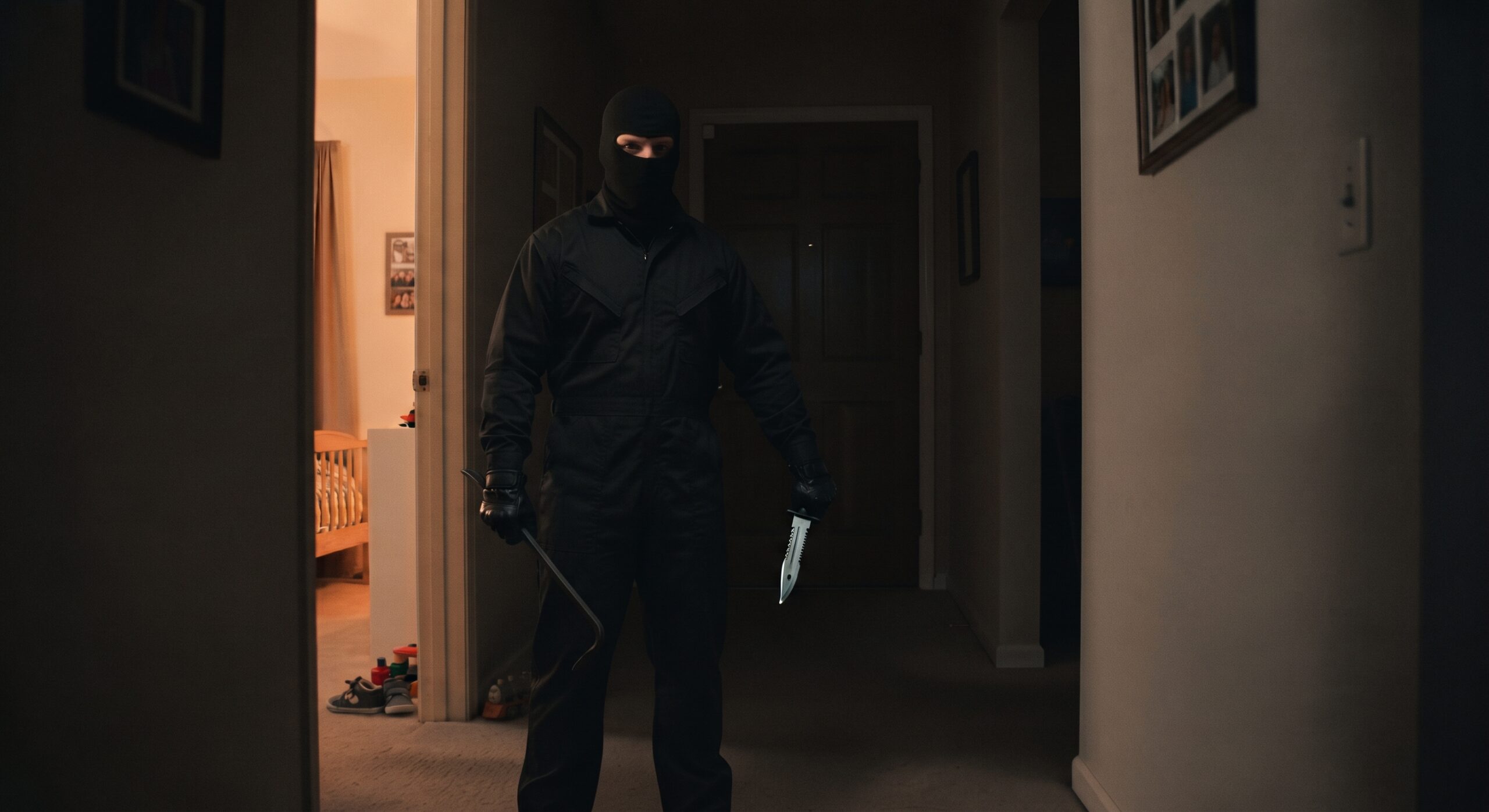
You wake to a crash somewhere in the house.
For a moment, you wait for an ordinary explanation. Something fell off a shelf. The dog knocked over a lamp. Then you hear the back door strike the wall, and your spouse sits up beside you.
Your children are asleep in separate bedrooms. Your phone is downstairs. You own a gun, but you haven’t decided who gets the children, who calls for help, or where anyone should go.
Your spouse asks what to do. Before you can answer, you hear your child’s bedroom door open.
That’s the part a new firearm won’t solve. Your family needs a shared understanding of what happens next, including what to do when you can’t all reach one another.
Home defense begins with a broad goal: keep everyone safe. The useful work is turning that goal into decisions about your actual house, your actual family, and an ordinary Tuesday night.
By the end of this process, you should have a one-page plan, a short repair list, and a date to walk through the plan together. Get a notebook and start with the people you’re protecting.
Map Your Family’s Needs Before You Map an Escape
List everyone who lives in the home. Beside each name, write where they sleep, whether they can leave independently, and what help they might need.
Be specific. “Help Mom” leaves too much unanswered. “Mom uses a walker, keeps her phone beside her bed, and needs assistance with the back step” gives you something to plan around. A toddler needs an adult. An older child may understand instructions but still need help with a stubborn lock.
Include hearing, vision, and communication needs. If someone removes hearing aids at night, shouting from another room may accomplish nothing. Ask that person what would work, and investigate appropriate alert equipment before relying on it. Include service animals and essential mobility equipment in the discussion.
Next, sketch the house. Draw bedrooms, exterior doors, stairs, and windows that could provide a safe exit. Mark where phones normally charge. Artistic ability doesn’t matter; being able to see the relationships between rooms does.
Now look at the house at three ordinary times: everyone asleep, everyone home and awake, and one adult home with the children. Mark where people would probably be in each case. A plan built entirely around two adults in the same bedroom leaves the parent making dinner alone without useful guidance.
Finish this step with two lists: people who need assistance and situations your plan must accommodate. Keep them beside the drawing as you make the remaining decisions.
Find the Weak Points Before Someone Else Does
Walk the house with your notebook. At each exterior door, check whether it closes fully and whether its lock operates properly. Look for damaged frames, loose hardware, and repairs everyone has learned to work around. Check the door connecting the garage to the house, too.
Open and close accessible windows, then verify that their locks work. Avoid adding security devices that could trap someone during a fire. If you’re unsure about an installation, have a qualified locksmith assess it. Renters should report defects and request approved repairs from the landlord.
Return after dark and look at each entrance. Can you see someone standing there without opening the door? Replace dead bulbs, adjust poorly aimed lights, and address vegetation that blocks your view. Check that emergency responders can read the house number from the street.
For every problem, record an action, a person responsible, and a date. “Back door needs attention” becomes “Alex calls the landlord Monday about the broken latch.” Fix an obvious defect before spending the same money on another camera.
If you have an alarm, learn exactly what an activation does. Does it sound locally, notify your phone, or reach a monitoring company? Who receives calls? What happens if the internet or power fails? Ask the provider about your particular system instead of assuming.
Finish by establishing a nightly check. Name the person who checks doors and windows, arms the alarm if appropriate, and confirms phones are charging where they’ll be accessible. Assign a backup for nights that person is away. Attach the check to an existing habit, such as turning off the living-room lights.
Know Where to Go When the Way Out Isn’t Safe
Take your drawing and consider the exits available from the rooms your family uses most. Walk those routes in daylight. Check whether the people expected to use them can operate the locks, manage the steps, and reach a suitable place outside.
Don’t count a window as an escape route merely because it opens. Its height, the drop outside, and the abilities of the person using it matter. Have unsuitable or uncertain escape arrangements reviewed by an appropriate professional. Keep fire evacuation requirements in mind when changing doors or locks.
Select an outside meeting place away from the house and a backup if that location is unsafe. A willing neighbor’s home may be an option, but speak to that neighbor first. Check whether the destination is accessible to everybody. “Outside” is too vague when people could leave through different doors.
Your family also needs an option when leaving would take them toward danger. Identify rooms that people can reach without crossing the threatened area, with a door they can close and lock and a way to contact help. Check the actual lock and phone reception. An ordinary interior door has limits; choosing a room doesn’t make it invulnerable.
Avoid making one bedroom the compulsory destination for everyone. If a child would have to pass an intruder to reach it, the rule has failed. Consider separate shelter options for different parts of the house and discuss how you’d tell emergency responders where people are.
Write the choices conditionally: “If we can leave without moving toward the danger, we use the safe exit and go to ____. If leaving would take us toward danger, we shelter in the nearest suitable room and call for help.”
This gives the family a decision they can understand. It also allows the response to change when the circumstances do.
Replace Conflicting Instructions With a Shared Plan
Start with the overnight situation. Decide which adult normally calls 911 and which adult normally assists each dependent, when that person can be reached safely. Name a backup for both jobs.
Write names rather than “one of us.” For example: “Jordan calls for help. Casey assists the toddler if safely reachable. When Casey is away, Jordan handles both responsibilities.” Those names are placeholders; assign tasks according to your family’s location, abilities, and preferences.
Then discuss what happens if someone is separated. This is an uncomfortable conversation, particularly when children sleep across the house. But “I’ll get them” leaves the hardest part unexamined. Identify what each person can do from their own room and what information an adult should give the dispatcher if a family member cannot be reached.
A young child may be unable to follow an independent plan. That limitation deserves attention now. Review sleeping arrangements, alerting, and adult availability, and seek help evaluating a layout that leaves you with no workable option. A written instruction can’t give a toddler adult judgment or make a dangerous hallway safe.
Decide how you’ll account for everyone. At the outside meeting place, one adult checks names and reports anyone missing, along with their last known location. Once safely outside, don’t reenter to search. Tell responders what’s missing from your picture of the situation.
Address pets before emotion makes the decision for you. Include an animal already beside you when it can be done safely, but don’t make searching the house for a hiding pet part of the plan. Give children that instruction clearly and kindly.
Repeat this exercise for the one-adult situation. If your plan requires two adults to work, you have more decisions to make.
Replace Conflicting Instructions With a Shared Plan
Imagine a household with two adults, a preschooler, and a twelve-year-old. During planning, they discover that the older child has been told both “come get us” and “stay in your room.” The adults also realize that both expected the other to bring a phone. Those are useful discoveries, even before anyone changes a lock.
They agree on clear instructions for the older child, assign responsibility for assisting the preschooler when safely reachable, and put a charger beside each adult’s bed. They discuss separate shelter options because their rooms aren’t all together. Then they repeat the conversation for nights when one parent works late.
Your answers may differ. The point is to replace an assumption with an assignment and check whether that assignment remains possible when circumstances change.
Choose plain instructions people can understand immediately. A complicated code word creates something else to remember. “Emergency, stay in your room” and “We’re leaving through the back door” communicate different actions. Discuss which instructions fit the options you’ve chosen, and keep them consistent.
Think about how instructions can reach people safely. A spoken warning might work in one layout; an accessible phone or alert device may be needed in another. Check audibility with bedroom doors closed during a scheduled practice. Avoid assuming a text will wake someone or that a device will work without power.
Explain the plan to children in language they can repeat. They should know how to seek help, what to do if separated, and that they shouldn’t go looking for the source of a frightening noise. Keep instructions short enough for their age and ability.
Ask them to tell you what they understand. “Do you get it?” often produces a nod. “What would you do if you heard that instruction while you were in bed?” reveals whether the message made sense. Correct confusion without turning the discussion into a frightening story.
Prevent Confusion at the Door. Put Help Within Reach.
Set an arrival routine for household members who return late. Decide how they’ll let others know they’re coming in, and make sure they have working keys and alarm access. These arrangements help reduce confusion. They don’t replace identifying a person and understanding what’s happening before any decision involving a firearm.
For unexpected visitors, agree that the door stays closed while identity and purpose are checked. Children should know which adults to contact. Verify an unannounced service visit through a number you obtain independently. These everyday rules reduce the number of situations your family has to improvise through an open doorway.
Put a charging location within reach of where an adult sleeps and check reception from the rooms you’ve selected. Make an ordinary call from each location. If service is unreliable, resolve it with the provider and investigate a suitable alternative rather than treating a weak signal as good enough.
Learn how to place an emergency call on the actual phones your household uses, including from the lock screen. Show capable family members where that function is without completing a practice call to 911. Use a pretend phone conversation for rehearsals.
Keep the full street address and unit number on a card inside the selected shelter room. Add access details that could help responders, such as a shared driveway. Children and guests may need the address, and a frightened adult can benefit from having it in front of them.
Practice a short opening using your address: “Someone is breaking into our home at ____. We’re in ____. There are ____ people here.” Then answer the call-taker’s questions. Report what you actually heard or saw, and distinguish that from what you suspect.
The National 911 Program advises callers to provide the location, callback number, and nature of the emergency, follow instructions, and remain connected until told to hang up. Call if you can; text if you cannot safely call and local text-to-911 service is available. Check that availability ahead of time through official local sources. 911.gov
If someone cannot be accounted for, say so. If a household member is armed, tell the dispatcher their location and description and follow instructions. When officers arrive, keep hands visible, follow commands, and don’t approach them carrying a firearm. Owning the home won’t tell arriving officers who everyone is.
Give Your Firearm a Clear Role and Secure Storage
A firearm introduces decisions that belong in this planning process. Who is trained and willing to use it? Who is authorized to access it? How will it be secured against access by children, guests, or anyone else who shouldn’t handle it?
Have that conversation directly. Your spouse may be comfortable calling for help and caring for a child but unwilling to handle a gun. Build assignments around that answer. An emergency is a poor time to discover that you’ve assigned someone a responsibility they never accepted.
Inspect your storage arrangements. Control keys and combinations, follow the manufacturer’s maintenance instructions, and account for visiting children as well as your own. Hiding a firearm on a shelf or in a drawer doesn’t prevent someone from finding it. Check applicable storage requirements where you live.
NSSF’s guidance for firearms kept for home security emphasizes appropriate training, safe handling, and preventing unauthorized access. It specifically asks owners to consider family circumstances and the views of other adults in the household. Those considerations belong alongside your own desire for access. www.nssf.org
Choose qualified instruction that covers judgment and safe handling as well as shooting. Learn applicable self-defense law from current authoritative sources and qualified legal instruction. Write “schedule training” or “review storage” on your action list, with a date, if either area is unresolved.
The family plan should prioritize escape or shelter when feasible and calling for help. Carrying a gun doesn’t make searching the house safe. A noise or movement alone doesn’t establish an imminent threat, and family members may be somewhere you didn’t expect. Knowing what you’re responding to remains essential.
Keep firearms secured throughout the household rehearsal. You’re testing communication and responsibilities, so there is no reason to introduce a gun into that exercise.
Walk Through the Plan and Find What Doesn’t Work
Schedule fifteen or twenty minutes when everybody is home. Explain the exercise first. Keep lights on, walk at a normal pace, and use no surprise noises or staged intruders. Children should understand that you’re practicing, not that something bad is happening.
Start with everyone in their usual overnight location. Describe a hypothetical break-in and ask each person to explain their first action. Walk only the routes you’ve identified as safe for that example. Have the designated caller give the address and describe the situation in a pretend call.
Watch for practical trouble. A child may misunderstand the instruction. A walker may not fit past a chair. A phone might be out of reach. Write those problems down as you find them and change the plan or the surroundings accordingly.
Next, change one condition: the usual exit is unavailable, one adult is away, or someone is in a different room. Ask how the plan changes. This checks whether people understand their options instead of remembering a single route.
Don’t grade your family on speed. Ask whether everyone knew what to do, could do it safely, and understood the backup. End with each person explaining their responsibility in their own words. Thank children for pointing out problems rather than pressuring them to perform perfectly.
Set a review date, then revisit the plan when bedrooms, work schedules, health, or household members change. Check alarm equipment through the provider’s testing procedure. Put repairs and maintenance on the calendar so the same unresolved problems don’t appear at the next rehearsal.
Give each unfinished task a concrete completion test. A phone problem is resolved when a normal call works from the intended location. A repair is complete when the door closes and locks properly. A communication problem is resolved when the person receiving the instruction can hear or otherwise receive it and explain the expected action.
If a task requires professional help, book it. If the household disagrees about an assignment, settle it before declaring the plan finished. Keep the first review focused on resolving those remaining gaps.
Put Your Plan on One Page and Your Repairs on the Calendar
Once you’ve worked through the house, condense your answers. Keep the detailed sketch for reference, but give the household a short version people can find and understand. Fill in these lines together:
- Our address and useful access information: ____.
- People who need assistance, their usual locations, and who helps them: ____.
- Safe exit options and circumstances that would make them unusable: ____.
- Outside meeting place and backup: ____.
- Shelter options when leaving would take us toward danger: ____.
- How we alert one another, including anyone with hearing or communication needs: ____.
- Primary person calling for help, backup, and accessible phone locations: ____.
- What changes when only one adult is home: ____.
- Nightly security check, responsible person, and backup: ____.
- Repairs or training to complete, who’s responsible, and dates: ____.
- Next household review: ____.
Keep the plan available to household members and appropriate caregivers without posting sensitive access information where visitors can see it. Store alarm passwords and firearm-access information separately and securely.
You don’t need to finish every improvement this weekend. Finish the first version of the plan, fix the most obvious defect, and put the remaining jobs on a schedule. A repaired latch, an accessible phone, and clear responsibilities may cost less than the next accessory you were considering.
Return to that moment in the bedroom. You still hear the crash. You’re still frightened. But the phone is within reach, your spouse understands their responsibility, and your children have practiced an age-appropriate response. You have fewer decisions to invent while someone is forcing their way inside.