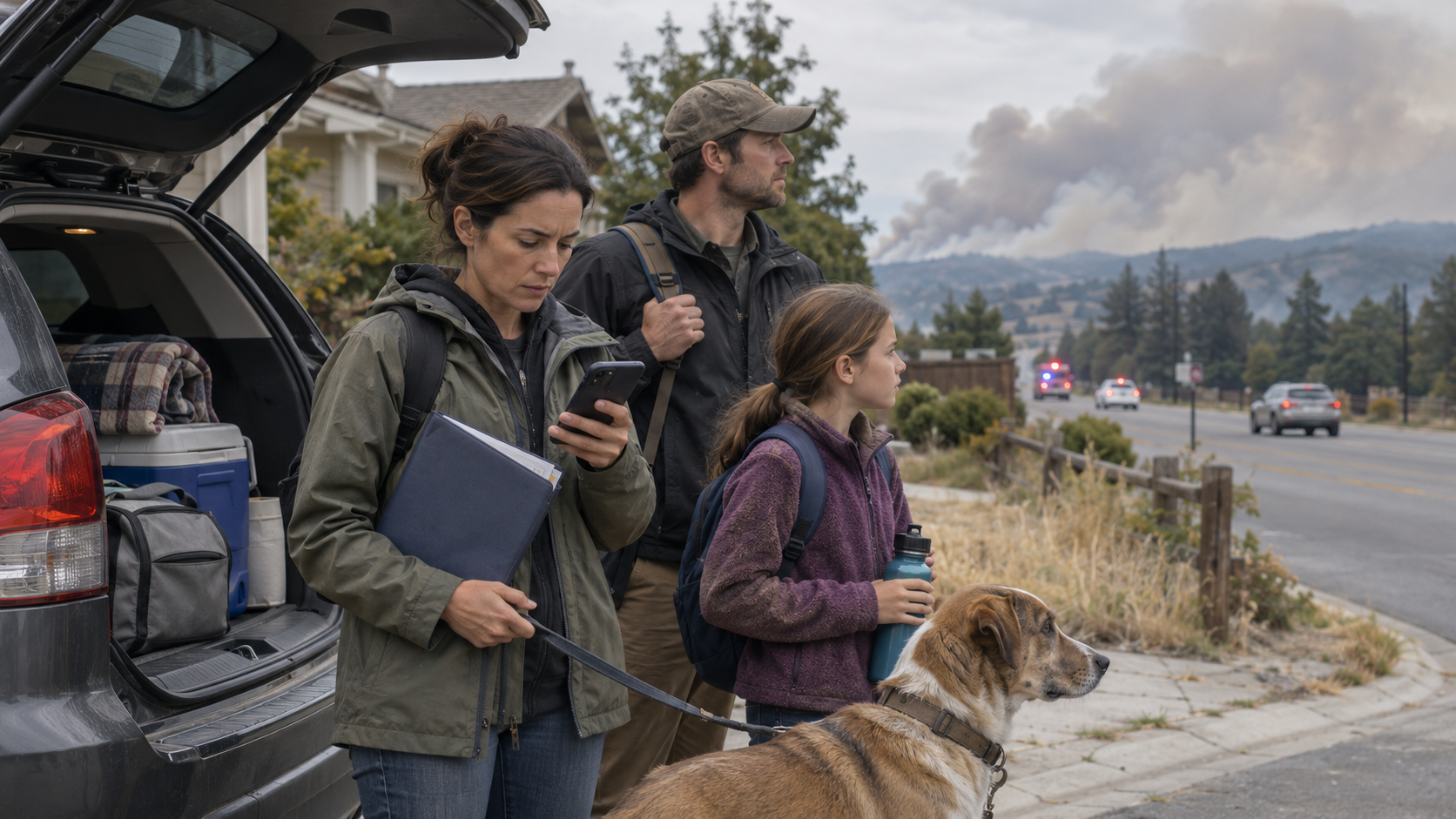
An evacuation notice arrives while you’re making dinner.
One person is at work. Your child is in another room. The dog is asleep under the table. You know there are important documents somewhere in the house, but you’re not sure where. You haven’t decided which road you’d take or where you’d go.
There may not be time to make those decisions carefully once an emergency is underway.
A useful evacuation plan starts with the people who need to leave, where they could go, and what they need to bring. A large bag of supplies can’t replace those decisions.
You don’t need to predict every emergency or build an elaborate system. You need a plan that fits your household, reflects the hazards in your area, and gives everyone a few clear next steps.
First Decide Whether to Leave or Shelter
Different emergencies call for different responses. Some require you to leave. Others may make it safer to stay indoors. Conditions can also change, so a plan that made sense earlier may need to change when officials provide new information.
That is why the first step is not “grab the bag.” It’s knowing how you’ll receive instructions and who you’ll trust for current information.
Check whether your city or county emergency management office offers local alerts by text, email, or phone. Find out how weather alerts reach your area. Save the relevant pages or phone numbers, and make sure everyone in the household knows where to look.
If your household uses a smartphone, check that emergency alerts are enabled. A phone is useful, but it shouldn’t be your only source of information. Keep a printed copy of key contacts and instructions with your household plan. Think about how you would get information if the phone battery died or service was unavailable.
If local authorities issue an evacuation instruction, follow it. Pay attention to which area is affected, when the instruction applies, and whether officials have identified routes or destinations. Don’t assume that your usual route is the right route during an emergency. The CDC advises following emergency routes and taking only essential items, including a phone, charger, medication, identification, cash, and a car emergency kit. www.cdc.gov
Also find out where your area posts updates if conditions change. A saved local emergency management page or alert subscription can help you check for new instructions without relying on rumors or an old social media post.
Start With the People Who Need to Leave
Make a list of everyone your plan needs to work for.
That might include children, older adults, someone with limited mobility, a person who depends on medication or medical equipment, or a pet that needs a carrier. Include anyone who may need extra time, help understanding an alert, or a particular kind of transportation.
Ask each person what they would need to leave safely. Don’t guess on their behalf. Someone who uses a wheelchair, hearing aids, a communication device, or other assistive equipment may have needs you haven’t considered. A person who needs help getting into a vehicle may require a different plan from someone who can leave independently but needs extra time.
Write down the kind of help that would be useful and who can provide it. Then name a backup person. The usual caregiver might be away, delayed, or unable to reach the household.
If anyone in your household needs accessible transportation, contact your local government or transportation provider ahead of time to learn what options exist. Don’t assume that transportation will be immediately available during an emergency. CDC guidance recommends planning around individual needs and sharing the plan with the people who may be involved in helping. www.cdc.gov
Include the person who needs assistance in the planning. A plan is more likely to work when it reflects what they say they need.
A few useful questions:
- Who may need help leaving?
- What kind of help is useful?
- How much time or equipment might that assistance require?
- Who can provide it?
- Who is the backup if that person is away?
- What would make the usual arrangement difficult?
If you have a child who may be at school or childcare when an emergency begins, learn the organization’s reunification and pickup procedures. Find out who is authorized to collect the child and how the organization will communicate with families. A household plan should account for those procedures rather than assuming you can simply drive to the school.
Choose a Destination and a Backup
Decide where you might go before you need to leave. Choose a primary destination and an alternative. Make sure everyone knows the address and how to get there.
The right destination depends on the emergency and official instructions. A friend or relative may be a reasonable option in one situation. In another, you may need a designated public shelter or a location outside the affected area. Check in advance whether your destination can accommodate everyone in your household, including anyone with access or medical needs and any pets.
If you plan to stay with someone, discuss it with them before an emergency. Make sure they know who may arrive and how to contact you. A plan that depends on someone else’s home should include a backup in case that person is away, the road is closed, or their own household is affected.
For a public shelter or other community resource, use current local information to confirm where people are being directed. Don’t assume that a place you used in a previous emergency will be open or suitable this time.
Think about household members who may be away when an evacuation begins. A child could be at school. One adult might be at work. Another person could be across town. Decide who will contact whom and what each person should do if returning home is unsafe or against official directions.
Don’t make “everyone meets back at the house” your only plan. If the house is inside the affected area, that may send people in different directions. Instead, choose a meeting place outside the immediate area and a second option farther away. Agree on who will make the decision to use the backup location and how everyone will find out.
Ready.gov recommends choosing meeting places, learning evacuation routes, and establishing an out-of-town contact as part of a family communication plan. www.ready.gov
Plan for the Route, Not Just the Address
Choose a primary route and an alternative. Consider what could make either route unavailable, such as a closure, heavy traffic, or an official instruction to travel another way.
Look at a map with the household. Make sure more than one person knows how to reach the destination. If a route depends on a bridge, freeway, or road that is easy to close, identify another reasonable option.
Your plan should be simple enough to remember. You don’t need to draw a complicated network of every possible road. You do need to know where to check for current conditions and what you’ll do if your usual route isn’t available.
If household members travel in separate vehicles, decide how they will stay in contact and whether they should go directly to the destination or meet at an agreed location. Avoid a plan that requires everyone to drive back toward an affected area just to travel together.
If someone in the household doesn’t drive, identify who can provide transportation and who can take over if that person is unavailable. If you rely on public transportation, find out where to check service updates during an emergency.
The route should also work for the people who are traveling. Consider whether the vehicle can accommodate mobility equipment, a car seat, a pet carrier, or other essential items. If not, identify the problem before you are under pressure.
Pack for Your Household, Not for a Generic Checklist
A supply list is useful only if it reflects what your household actually needs.
Start with the items that would be difficult to replace quickly:
- Prescription medication and essential medical supplies
- Glasses, hearing aids, mobility aids, or communication devices
- Identification and important health information
- Phone chargers, a portable charger, and keys
- Supplies for children, dependents, and pets
- Weather-appropriate clothing and basic personal items
For medication that needs refrigeration or other special handling, ask your pharmacist or healthcare provider how to plan for a temporary move. Don’t wait until an alert is active to figure out what is safe. Keep a current medication list with the relevant health information, and know where it is.
CDC recommends that emergency plans account for individual health needs, medical information, assistive devices, and important contacts. www.cdc.gov
You may want some supplies stored together, but don’t let a bag become the plan. If it’s too heavy, hard to find, or full of items no one knows how to use, it won’t help much. Keep the list short enough to act on under pressure.
Think about what you use every day. If someone in your household wears glasses, keep glasses near the person or include a spare if available. If someone relies on a powered device, plan for its charging needs. If a child depends on a particular comfort item, think about whether it is easy to locate and carry.
Some items can be packed in advance. Others, such as a phone, medication currently in use, or a mobility device, may need to be picked up as you leave. Mark those items on the plan so no one has to remember them from scratch.
Don’t let packing take priority over leaving when it is time to go. Your plan should make it clear which items matter most and which can be left behind.
For pets, decide how you’ll safely transport them and where they can go. Keep carriers, leashes, food, and any needed medication in a known place. Make sure your pet’s identification is current, and check whether your planned destination accepts pets. Don’t assume it does. Ready.gov’s pet planning guidance recommends including pets in the household emergency plan and checking their transportation and supply needs in advance. www.ready.gov
Plan How You’ll Communicate
Make a short household communication plan.
Choose one person outside your immediate area who can serve as a contact if household members are separated. Everyone should know the person’s name and number. Agree on a brief check-in message with your location and status, such as: “We’re safe. We’re at the west library parking lot. We’re heading to Aunt Maria’s.”
If someone is away from home, decide whether they should go directly to the destination or use a designated meeting place. Make sure children know whom they are allowed to leave with and what they should do if they can’t reach a parent or caregiver.
Don’t depend on every person being able to make a phone call. A short text may work when a call does not, but communication can still fail. Keep the out-of-area contact and meeting place on paper as well as in phones.
If a household member uses an assistive communication device or needs information in a particular format, include that in the plan. CDC recommends making a contact list of people who support individual needs and considering how communication will work if the power is out or phones don’t work. www.cdc.gov
Decide Who Does What
Be specific about responsibilities. Who helps the person who needs assistance? Who takes the pet carrier? Who checks for official updates? Who drives? Who takes the written plan?
Assign backups in case the person with the usual responsibility isn’t home. The household member who normally cares for a pet may be at work. The person who knows where the medication is may be away. A plan that depends on one person’s presence is incomplete.
Don’t assign anyone the job of going back into an unsafe area to collect another person or item. If someone is separated, use the communication and meeting plan and follow instructions from local authorities.
Write down the plan, then share it with anyone who may need to help. Keep a copy where household members can reach it without searching through a phone. If another caregiver, neighbor, or family member may assist, make sure they know the basic responsibilities and how to contact the household.
A calm conversation is enough for a first review. Ask each person:
- Where would you go?
- Who would you contact?
- What would you take?
- Who would you help?
- What would you do if the usual driver or caregiver wasn’t available?
If the answers don’t match, make the plan clearer.
Review and Practice the Plan
A plan can become outdated. A family may move. A child may start a new school. A prescription may change. A household member may need new transportation or assistance. Review the plan when those changes happen, and choose a regular date to check it even when nothing obvious has changed.
Practice the parts that are easy to forget. Make sure everyone can find the written plan, identify the meeting places, and contact the out-of-area person. If you use a go-bag, check that it is still accessible and that its contents are appropriate.
You don’t need to stage a dramatic drill. Walk through the plan during an ordinary evening. Ask each person to explain what they would do if they were at home, at work, or at school when an alert arrived. Identify one point of confusion and fix it.
If a plan depends on equipment, check that the equipment is available and that the person who needs it can use it. If it depends on another person’s help, confirm that the person still agrees and knows what may be expected of them.
CDC recommends practicing, reviewing, and sharing emergency plans with the people who may provide support. www.cdc.gov
Put the Essentials on One Page
Official alert sources: ____
Primary destination and backup: ____
Primary route and alternative: ____
Household members who may need help: ____
What assistance or transportation they need: ____
Essential items to take: ____
Pet plan and supplies: ____
Out-of-area contact: ____
Meeting place if we’re separated: ____
Who does what, with backup assignments: ____
What changes if the usual driver or caregiver is away: ____
Next review date: ____
A plan won’t tell you exactly what to do in every emergency. It can help you avoid making the first important decisions while trying to find medication, contact family, and choose a destination at the same time.
Start with the people. Choose where you could go. Write down what you need to take. Then make sure everyone knows the plan.
Sign up for The Ready Network mailing list and get the free ebook, Navigating Real-World CCW Scenarios.