Most concealed-carry training focuses on what to do with a firearm. That skill matters, but it is only one part of responsible preparation.
There is another set of skills that comes into play earlier: noticing when an ordinary interaction is changing, managing your own response, keeping options open, and leaving when you can. Those skills do not require a firearm. They are useful precisely because they can help keep an encounter from becoming a confrontation.
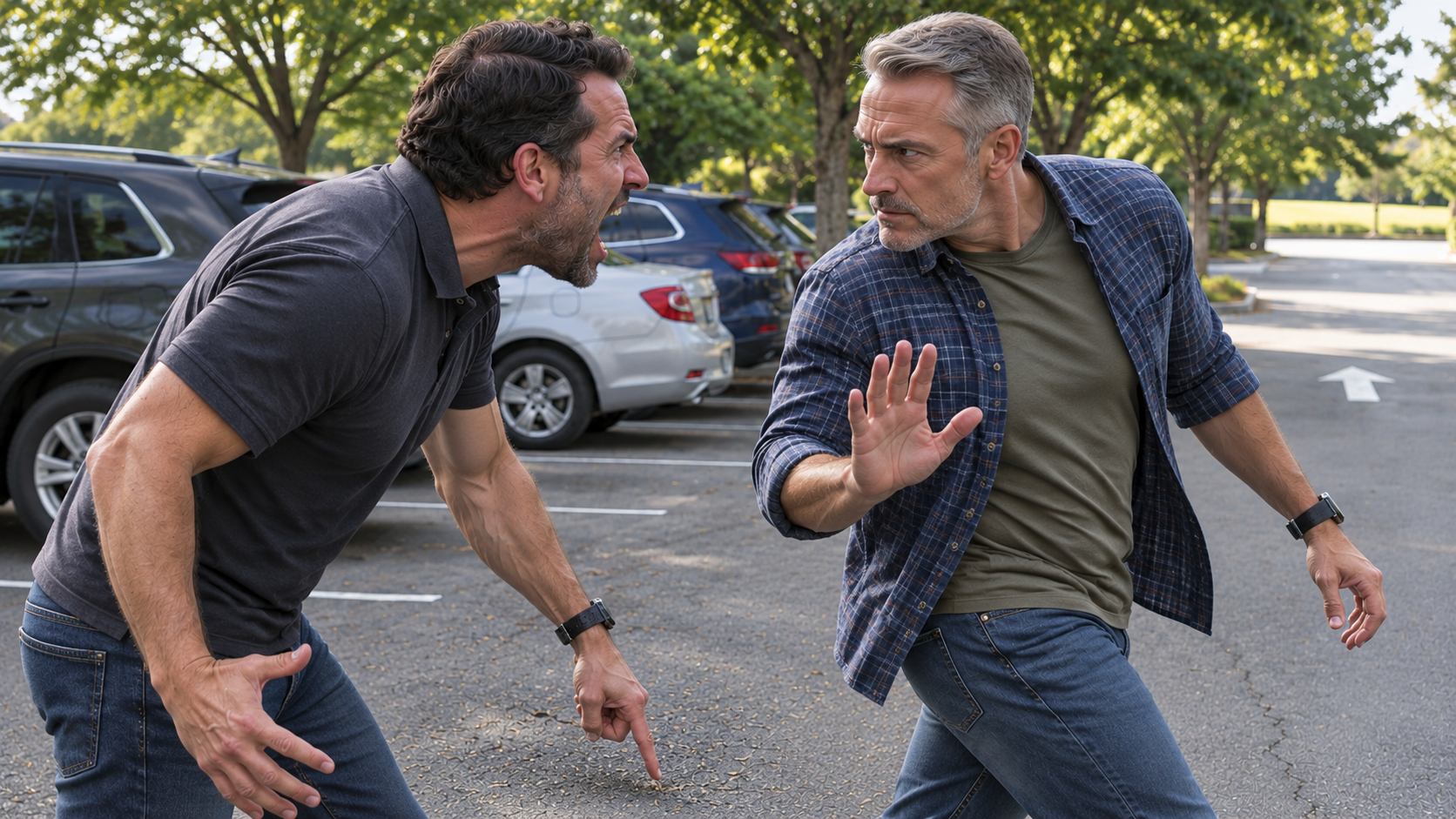
Imagine that you are walking back to your car after dinner. Another driver says you took their parking spot. The first comment is irritated. Then the person raises their voice and steps closer. You have a choice: argue about who was there first, try to prove your point, or recognize that the interaction is becoming less useful and leave.
That choice is not always simple. People get angry, embarrassed, startled, or worried about how they look to others. They may feel pressure to defend themselves verbally. They may believe they need to stay until the other person understands. In a tense moment, those impulses can narrow the options they see.
This article covers practical skills for noticing changes, creating space, speaking clearly, and disengaging when possible. It is general education, not legal advice, a use-of-force standard, or a guide to deciding when to draw a firearm. Firearm handling and scenario practice belong in qualified instruction.
Situational Awareness Without Hypervigilance
Situational awareness does not mean treating every stranger as a potential threat. It means paying ordinary attention to where you are, who is with you, and what is changing around you.
When you enter a store, restaurant, parking lot, or other familiar place, you probably notice more than you consciously think about. You see the counter, the door, the people you are with, and the route back outside. You do not need to memorize every detail or watch everyone closely. A calm awareness of your surroundings is enough to help you make ordinary choices.
The useful question is not, “Who here looks dangerous?” Appearance is a poor substitute for evidence. Clothing, age, race, tattoos, or a person’s general manner do not tell you with certainty what they intend to do. Focusing on stereotypes can make you misread harmless behavior and miss what is actually changing.
A better question is: “What has changed in the situation?” Perhaps an argument that was quiet is becoming loud. Someone who was standing nearby is now following you. A person is repeatedly ignoring a request to give you space. These are observations about behavior and context, not conclusions about what will happen next.
Even then, one behavior does not prove intent. A raised voice may be unpleasant without becoming a threat. A person may move closer because a room is crowded. Context matters. The point is not to diagnose another person. It is to notice when you may want to reassess your own choices.
A useful habit is to notice three ordinary things when you enter a place: how you would leave, who is with you, and where you could ask for help if you needed it. Then go about your business. You are not conducting surveillance. You are keeping a basic map of your surroundings in mind.
Notice Changes, Not Just Conflict
Many situations begin with disagreement rather than immediate danger. Someone complains about a parking space. A stranger is angry about a place in line. Two people argue near you. The presence of conflict alone does not tell you how it will develop.
What matters is whether the interaction changes. Is the person continuing to argue after you have tried to end the conversation? Are they closing distance while you are trying to leave? Are they blocking a route? Are their words becoming more direct or threatening? Is someone else being drawn into the dispute?
These questions help you stay specific. “This person is a bad person” is a judgment. “They have followed me across the lot after I walked away” is an observation. The observation gives you better information to act on.
It also helps to separate what you know from what you are assuming. In the parking-space example, you know the other driver is angry and has stepped closer. You may be assuming that they intend to attack, or that they will calm down if you explain the parking arrangement. Neither assumption is certain.
When you notice a change, you do not have to wait for certainty before considering ordinary options. You can end the discussion, move toward other people, or seek assistance. Reassessing is not an accusation. It is a way to keep your choices responsive to what is actually happening.
This does not create a reliable prediction system. No checklist can tell you exactly what another person will do. It can help you avoid two common errors: dismissing meaningful changes because you do not want to seem rude, and treating ambiguous behavior as proof of the worst possible outcome.
Create Space and Preserve a Way Out
Space gives you more options. It can make it easier to leave, easier to communicate, and less likely that you will feel trapped in a conversation. This is ordinary personal-space awareness, not a plan for a fight.
When an interaction becomes uncomfortable, notice where the nearest ordinary exit is. Is there a doorway, a staffed counter, a public area, or another place you can move toward? If you are with someone else, can you leave together? Is the route open, or would leaving require you to move closer to the person?
You do not have to announce every decision. You can simply say, “I’m leaving,” and begin moving away if it is safe to do so. You can also change direction, end the conversation, or approach staff. The best option depends on the setting. There is no single movement that works everywhere.
Avoid giving up space just to make a point. Moving closer to emphasize an argument can make the interaction feel more confrontational. Reaching toward someone, touching them, or standing in their path can also make it harder to disengage. If your goal is to end the interaction, your movement should support that goal.
The parking-space disagreement offers a simple example. You might be tempted to keep explaining that you were parked there first. But if the person keeps closing distance, the argument is no longer just about parking. You can stop trying to resolve the dispute, move toward the restaurant entrance or another public place, and ask staff for help if needed. That may feel unsatisfying. It can still be the more practical choice.
Creating space is not always possible. A narrow hallway, a crowded bus, or a situation involving a family member may limit your options. In those cases, focus on identifying the safest available choice and getting help when appropriate. The goal is not to force an exit that does not exist. It is to avoid closing off the options you do have.
Use Fewer Words
When people feel challenged, they often explain more. They repeat their point, correct details, or try to make the other person admit they were wrong. That response is understandable. It can also keep an interaction alive after it has stopped being productive.
In a tense moment, short and plain language is often easier to control. “I don’t want to argue.” “I’m leaving.” “Please give me space.” These are examples, not magic phrases. They cannot guarantee another person’s response. Their purpose is to state your intention clearly without adding insults, threats, or a new argument.
Try to avoid questions that are really challenges: “What are you going to do?” “You think you’re tough?” “Are you threatening me?” Such phrases can push a conversation toward a contest. If you want to leave, say so. If you need help, ask for it directly.
You do not need to win the conversation before you end it. You do not need the other person to agree that you are right. You do not need to answer every accusation. In the parking-space example, you might give one brief response, then stop debating and leave if possible.
Your voice matters, too. Speaking at a controlled volume can help you avoid adding to the intensity. That does not mean whispering, pretending to be cheerful, or sounding submissive. Aim for clear and steady. If you are upset, take a moment before speaking. A slow exhale can help you avoid blurting out the first angry sentence that comes to mind.
One practical method is to choose a short boundary phrase ahead of time. Pick language that sounds like you. Say it aloud once or twice when you are calm, so it is familiar. Do not rehearse a dramatic speech or a string of commands. The skill is to keep the message simple enough to use under pressure.
There will be situations where speaking is not the right choice, where the other person cannot hear you, or where words may intensify the interaction. No phrase is universally safe or effective. Use judgment, focus on your own choices, and leave room to change course.
Let Your Body Support Your Words
People communicate with more than words. Their volume, gestures, distance, and facial expression can reinforce or contradict what they are saying.
If you say “I’m leaving” while stepping toward someone, pointing at them, or continuing to argue, your behavior may communicate something different. If your goal is to disengage, make your movement and words consistent with that goal.
Avoid unnecessary contact. Do not grab, push, block, or touch someone to make a point. Avoid gestures that turn the conversation into a challenge. If you need to move, move in a way that supports leaving or getting help rather than crowding the other person.
It can also help to notice your own physical signs of anger or stress. Are you clenching your jaw? Are your shoulders tense? Are you leaning forward? Are you speaking faster and louder? These signs do not mean you are about to lose control. They are cues that you may want to pause, lower your voice, and make a deliberate choice.
The aim is not to perform a special posture or copy law-enforcement commands. You are a civilian managing your own conduct in an uncertain situation. Keep your actions ordinary, clear, and consistent with your intention to de-escalate or leave.
If you are with someone else, make sure your communication does not pull them into the argument. Avoid telling a companion to confront the person or prove your point. A simple “Let’s go” can be more useful than a whispered debate about who is right.
Disengagement Is a Skill
Leaving can feel like losing. A person may think, “If I walk away, they’ll think they won.” That reaction is human. It can also keep you in a conversation that no longer serves any purpose.
Disengagement means ending your participation when you can. It may involve a short statement, a change in direction, or simply stopping the conversation. It can mean moving toward staff or other people rather than remaining isolated. The exact action depends on the setting.
A common mistake is to leave physically but continue the argument from a distance. A person may turn back, shout another comment, or come back to retrieve the final word. That reopens the interaction. If you have decided to disengage, try not to restart the dispute after you have created distance.
Another mistake is to keep explaining. People often believe that if they just find the right words, the other person will understand. That may happen. It may not. If the person is angry and continuing to press the conflict, further explanation can give the argument more time and attention.
This does not mean you should ignore every problem or never ask for assistance. If you need help, seek it. If someone else is at risk, consider what assistance is available. Disengaging from an argument is different from abandoning a person who needs help. The situation matters.
It is also possible that leaving is not immediately available. You may be in a crowded space, responsible for a child, or unable to move safely. In that case, do not treat “just leave” as a complete answer. Focus on reducing unnecessary argument, looking for help, and reassessing as conditions change.
The key skill is being willing to stop participating in a contest. You can disagree and still leave. You can feel angry and still leave. You can believe you are right and still decide that continuing the argument is not worth it.
If You’re With Someone Else
An interaction becomes more complicated when you are responsible for a child, spouse, friend, or family member. You may feel pressure to defend them, speak for them, or prove that you are in control. That pressure can make it harder to disengage.
Talk with family members about simple expectations before an emergency. For example: if one adult says it is time to leave, the others should come along rather than stay to argue. A child does not need to solve the conflict or protect the adult. The adult’s job is to make the decision and guide the family away when possible.
Keep the conversation calm and ordinary. You do not need to teach children to scan every person they see or treat public places as dangerous. You can explain that if a disagreement becomes uncomfortable, the family can leave together and ask an employee for help.
With another adult, agree on a simple phrase that means “let’s go.” It should not be a secret tactical signal or an elaborate plan. It can be as ordinary as “We’re heading out.” The value is that both people understand the intention and do not accidentally prolong the argument.
If a companion wants to stay and debate, avoid turning that disagreement into a second conflict. A quiet, clear request to leave is more useful than criticizing them in front of the other person. When possible, move together. If you need help, ask staff or another appropriate person.
The goal is not to control everyone around you. It is to communicate with the people you came with, reduce confusion, and avoid turning a tense exchange into a group confrontation.
Make Decisions Under Pressure
Stress can make it harder to think through several choices at once. That is one reason a simple mental sequence can help. It is not a formula for predicting danger or deciding whether a firearm should be drawn. It is a way to pause and organize your attention.
Ask yourself:
- What changed? Describe what you observed without adding a guess about motive.
- What do I know, and what am I assuming? Separate direct information from interpretation.
- What ordinary options are available? Consider leaving, creating space, ending the conversation, or getting help.
- What action supports the option I want? If you want to leave, stop arguing and move toward an exit if it is safe.
- Has the situation changed again? Reassess rather than sticking to a plan that no longer fits.
Consider the parking-space example again. The other driver complains. You know they are angry. You do not know whether they intend to cause harm. You notice they are stepping closer while continuing to argue. You decide not to keep debating. You say, “I don’t want to argue,” and move toward the restaurant entrance. If the person follows, you reassess and seek help.
That is not a promise that the situation will end peacefully. It is a demonstration of the skills: observe, distinguish fact from assumption, choose an ordinary option, and reassess. The person does not need to be certain about the other driver’s intentions before deciding that the argument is over.
The framework also helps prevent overreaction. If nothing has changed beyond a sharp comment, you may decide to continue with your evening without escalating. If the situation changes, you can change your response. You are not locked into the first interpretation you made.
There is no civilian checklist that replaces local law, individual judgment, or qualified instruction. This article does not set a legal threshold for drawing or using a firearm. Questions about the law belong with a qualified attorney. Firearm-specific decisions belong in a training environment led by a qualified instructor.
Common Habits That Keep a Conflict Going
Some habits make it harder to disengage. Most are familiar because they appear in ordinary arguments, not just serious confrontations.
- Staying to prove you are right. You may be right about the parking spot, the line, or what someone said. The other person may not accept your explanation. Ask whether continuing the discussion is useful.
- Moving closer to emphasize a point. Closing distance can make the interaction feel more confrontational and reduce your own options. If your goal is to leave, moving toward the person works against that goal.
- Matching the other person’s volume. Raising your voice may feel like standing your ground. It can also keep the exchange escalating. Speak clearly, then stop adding fuel.
- Using sarcasm or insults. A cutting remark can feel satisfying for a moment. It also gives the other person another reason to continue the argument.
- Assuming you know what someone intends. A person can be rude without being dangerous. A person can also behave in a concerning way without matching a stereotype. Focus on observable conduct and changing conditions.
- Turning a boundary into a threat. “I’m leaving” communicates an intention. “You’ll regret this” creates a new challenge. Use language that supports disengagement.
- Re-entering the interaction. Walking away and then returning to argue again defeats the purpose. If you have decided to leave, keep moving toward the next safe, ordinary step.
The aim is not to become perfect at conflict. It is to recognize the habits that keep you engaged and choose a different response when possible.
What to Look for in a Training Class
A class on concealed carry should not treat marksmanship as the only skill that matters. Ask whether the instructor covers awareness, communication, disengagement, and decision-making as well as firearm fundamentals.
Useful questions include:
- How does the class teach students to recognize changing circumstances?
- Are alternatives to drawing discussed?
- Are scenarios controlled and followed by a debrief?
- What are the safety rules?
- Is the instruction appropriate for my experience?
- Can students pause or ask questions during an exercise?
A responsible class should explain its format and safety procedures before practice begins. Firearm handling should follow the instructor’s rules and the facility’s policies. NSSF’s firearm-safety guidance emphasizes safe muzzle direction, trigger discipline, and familiarity with the firearm being handled.
Be cautious of training that promises certainty or presents every situation as a test of toughness. Real situations vary. A scenario can help you notice habits and receive feedback; it cannot guarantee how you will act in an emergency.
Also distinguish civilian education from law-enforcement training. Some de-escalation materials are designed for officers carrying out specific duties and are not universal civilian instructions. The Department of Justice’s use-of-force policy, for example, applies to DOJ law-enforcement component agencies. Ask an instructor to explain how their course applies to responsible civilian decision-making.
The Skills to Carry Into Your Next Day
You do not need to turn every outing into a training exercise. You can start with a few practical habits:
- Notice the setting and how you would leave.
- Pay attention to what changes, not what a person looks like.
- Separate what you observed from what you are assuming.
- Use short, clear language instead of arguing.
- Keep your actions consistent with your intention to disengage.
- Leave when you can, and seek help when appropriate.
- Reassess if the situation changes.
These are not guarantees. They do not make every situation predictable or remove the need for qualified training. They are skills for keeping options open and reducing the chance that pride, anger, or confusion will make a tense moment worse.
Responsible preparation includes learning how to handle a firearm safely. It also includes learning how to avoid unnecessary conflict, communicate clearly, and leave an argument without needing the other person to agree with you.