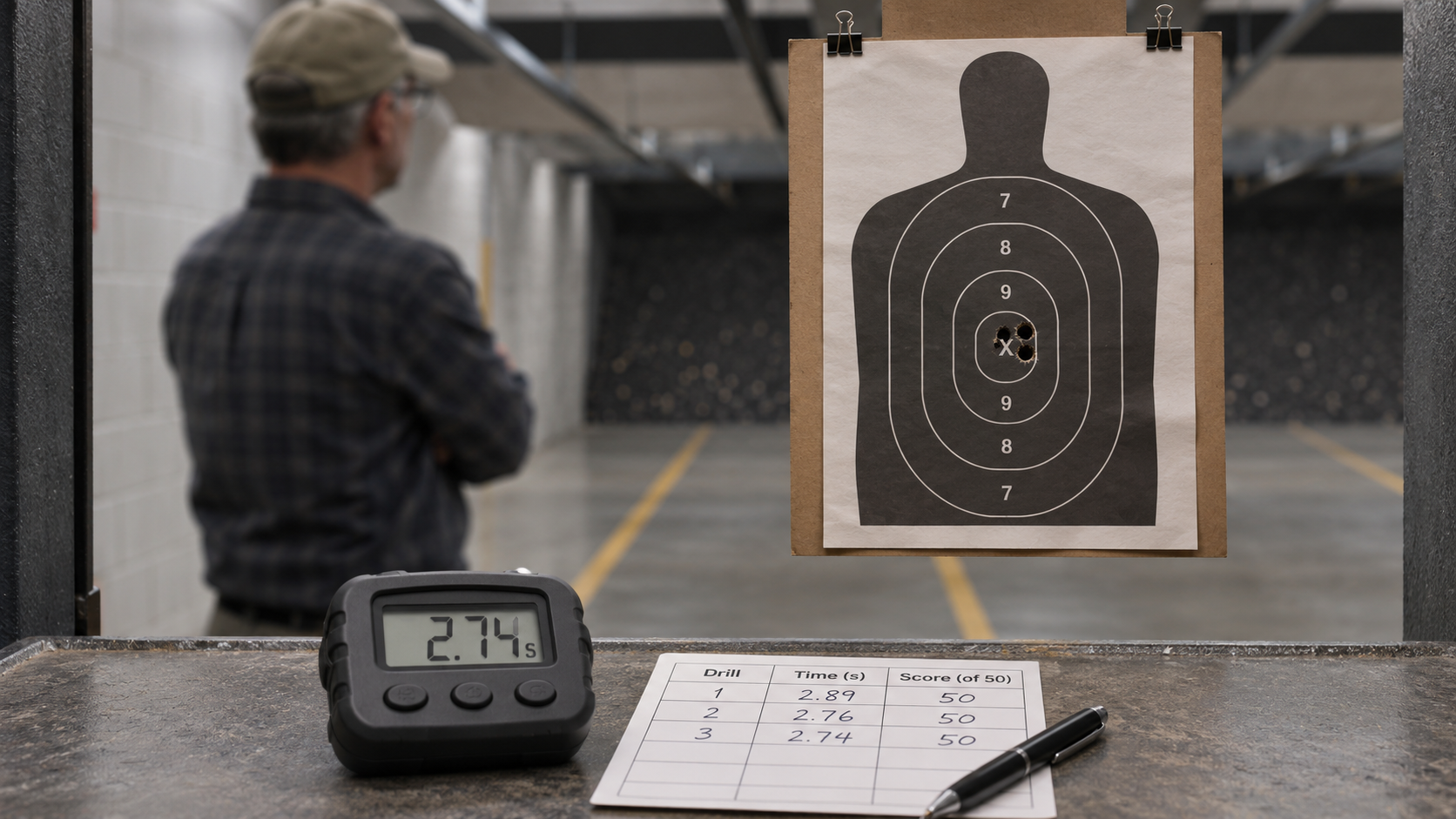
A shot timer can make a range session feel more serious. It gives you a number to chase, a way to compare repetitions, and a quick answer to the question, “Was that faster?”
But the timer does not tell you whether the shots were accurate. It does not tell you whether you repeated the same skill several times or got one lucky run. And it does not tell you whether you followed safe handling practices.
A faster time only matters if you can maintain the standard you set for the exercise. If your hits spread, your control falls apart, or you start ignoring range commands, the timer is showing you that you moved faster than your current skill could support.
This article lays out a practical way to measure both speed and accuracy. You’ll establish a baseline, add time pressure gradually, and use repeatable drills to decide when to move forward and when to slow down. The drills use a stationary target and a range-approved starting position. They do not include drawing from a holster. Add holster work only under qualified instruction and when the range specifically permits it.
The Timer Is a Tool, Not the Goal
A timer measures elapsed time. That is useful information, but it is only one part of performance.
Suppose one repetition takes 1.8 seconds and all the hits are in the area you chose. Another takes 1.5 seconds, but one shot lands outside that area. The second repetition was faster. It was not necessarily better.
A useful training session asks four questions:
- Time: How long did the repetition take?
- Accuracy: Did the shots meet the standard you set?
- Consistency: Could you repeat the result?
- Safety: Did you handle the firearm safely and follow the range’s rules?
The last question is not optional. NSSF’s firearm-safety guidance emphasizes maintaining a safe muzzle direction, keeping the trigger finger outside the trigger guard until ready to shoot, and knowing your target and what is beyond it. These responsibilities continue to apply when you add a timer.
A single fast run can be exciting. A repeatable result tells you more. If you can produce accurate, controlled repetitions at a particular pace, you have a useful baseline. If you cannot, you have useful information too: that pace needs more work.
The purpose of training is not to produce the most impressive number on a timer. It is to develop a skill you can perform consistently within a safe, clearly defined standard.
Define a Successful Repetition Before You Begin
Before you set up a drill, decide what counts as a successful repetition. If you make that decision after seeing your score, it is easy to move the standard to excuse a miss or celebrate a fast run.
Choose a target and a clearly marked scoring area that are appropriate for your experience and the range. Your instructor can help select them. The area should be easy to see and score. Avoid making it so large that almost any shot counts, or so small that your current skill makes meaningful practice impossible.
A successful repetition for this article has three parts:
- The shots meet the chosen accuracy standard.
- The shooter maintains safe handling and follows range commands.
- The time is recorded, whether or not it is a personal best.
This is a training standard, not a statement about what accuracy is legally or tactically sufficient in any real situation. Range performance cannot establish what a person should do in a real-world encounter.
Choose consistent conditions
To make useful comparisons, keep the conditions as similar as you can:
- Use the same target and scoring area.
- Keep the same distance.
- Use the same range-approved starting position.
- Fire the same number of shots per repetition.
- Use the same firearm and setup during a training block.
- Record the same measurements each time.
If you change several things at once, you will not know what caused the result to change. For example, if you switch targets, move farther away, add a holster draw, and shorten the time limit in the same session, a miss will not tell you which change exceeded your current skill.
Select a starting position the range allows
For the drills below, use a stationary, range-approved starting position. Many ranges have specific rules about ready positions, timers, and how firearms may be handled. Follow those rules and the range officer’s directions.
This article does not teach a holster draw. If you want to add a draw, ask a qualified instructor where and how that skill may be practiced. Do not assume that every range permits it.
Before You Start: Make the Session Safe and Repeatable
A timer adds urgency. That urgency can distract you from basic safety habits if the session is poorly organized. Before beginning, make sure you know the range’s procedures and that the drill fits your experience.
If you are new to live-fire practice, have questions about your firearm, or are not comfortable using a timer, get instruction before trying the drills. NRA pistol-marksmanship instruction covers fundamentals such as sight alignment, trigger control, grip, and breath control; those fundamentals remain the foundation when a shooter adds a timer.
Prepare the drill before handling the firearm
Before going to the firing line, decide:
- Which target you will use.
- How many shots are in each repetition.
- What score area you will use.
- How many repetitions you plan to complete.
- How you will record time and hits.
- What condition will make you stop or slow down.
Write this down. A small note card or phone note can hold the plan, but do not handle your phone while holding a firearm. Put it away before handling the firearm, and record results only when the firearm is in the condition and location required by the range.
Use the range’s safety procedures
Follow the range’s commands, procedures, and handling rules. If the range does not allow timers or the starting position you intended to use, do not improvise. Ask the staff or instructor how to adapt the exercise.
Stop the exercise if:
- You are unsure of a command or instruction.
- The timer distracts you from safe handling.
- You feel rushed or lose control of the exercise.
- The range officer calls a stop.
- You are tired enough that your attention is slipping.
The timer can wait. A training session is not improved by continuing after you stop paying attention to safety.
Drill One: Establish an Untimed Accuracy Baseline
The baseline tells you what you can do at a comfortable pace before you try to improve the time. It gives you a point of comparison for later sessions.
Setup
Choose a stationary target and a range-approved starting position. Use a distance that is appropriate for your current experience and the target standard you chose. If you are uncertain, ask an instructor.
Set up a scorecard with these columns:
| Repetition | Hits in chosen area | Total shots | Time, if recorded | Notes |
| 1 | ||||
| 2 | ||||
| 3 |
For the baseline, fire three repetitions of five shots each at a comfortable, untimed pace. If your instructor or range recommends a different number, follow that guidance. Do not try to compensate for an early miss by rushing the next shot.
After each repetition, follow the range’s procedures before checking the target. Record every shot, including misses. The goal is not to make the scorecard look good. The goal is to describe what happened.
What to record
For each repetition, note:
- How many shots landed inside your chosen scoring area.
- Whether the group was relatively consistent.
- Whether you noticed a change in your grip, sight focus, or trigger control.
- Whether you felt rushed, even without a timer.
- Whether anything about the target, distance, or range setup made scoring difficult.
Avoid overinterpreting one group. This is a baseline, not a diagnosis. If the results are inconsistent, repeat the same exercise during another session before changing equipment or technique. If you need help understanding the target, ask an instructor rather than trying to diagnose yourself from an online chart.
How to use the baseline
The baseline gives you a reference point. It may show that you meet your chosen accuracy standard comfortably, that you need more untimed work, or that your performance varies considerably from one repetition to the next.
Any of those outcomes is useful. If your accuracy is not consistent at a comfortable pace, adding a timer will usually make it harder to see what needs attention. Continue working at a pace that lets you follow your instructor’s guidance and meet the chosen standard.
Drill Two: The Accuracy-First Speed Ladder
The speed ladder adds time pressure in small steps. The rule is simple: speed increases only when accuracy and control stay consistent.
Do this drill only where the range permits the timer and starting position. If you are not familiar with timer use, ask an instructor to supervise.
Step 1: Choose a starting pace
Begin at a pace where you expect to meet your accuracy standard without rushing. If you have a previous session’s results, use the time associated with your best repeatable performance, not your single fastest run.
If you do not have a time yet, complete one short, comfortable repetition and record the result. Do not make the first attempt a contest.
Step 2: Complete a short string
Use the same target, distance, shot count, and starting position as the baseline. For example, you might use a five-shot string from the range-approved starting position. The precise format should fit the range rules and your instructor’s guidance.
After each repetition:
- Follow the range’s procedures.
- Check the target when permitted.
- Count all hits inside the chosen area.
- Record the elapsed time.
- Note whether you maintained control and followed all commands.
Complete three repetitions at the same pace before deciding whether to change it.
Step 3: Decide whether the pace is repeatable
Move one small step faster only when all three repetitions meet the chosen accuracy standard and you maintained safe handling.
If one repetition fails the standard, do not erase it from the record. Mark it as a miss and repeat the same pace in a later string. If misses continue, return to untimed work or ask an instructor to review your fundamentals.
A successful run means the standard was met. It does not mean that the next run must be faster.
Step 4: Increase time pressure gradually
If you have access to an adjustable timer, reduce the available time by a small increment. Use an increment the timer allows and that your instructor considers appropriate. Do not use a dramatic reduction just to make the drill feel challenging.
Complete three repetitions at the new pace. Then score them using the same standard. If the hit quality or control drops, return to the previous pace.
A useful rule for the article is:
One variable changes at a time. The accuracy standard does not change to accommodate the timer.
You may eventually reach a pace where your results become inconsistent. That is not a reason to force the next step. It identifies the boundary between your current repeatable skill and a pace that needs more work.
Step 5: End on a deliberate note
Do not finish by trying to beat your fastest time at any cost. End the session when you are tired, frustrated, or no longer maintaining control. If you choose to do a final repetition, use a pace where you can focus on the same standard you set at the beginning.
The point is to leave with an honest record, not an inflated personal best.
Drill Three: The Consistency Check
A shooter can produce a fast repetition once and still be inconsistent. This drill asks a different question: can you reproduce the result?
Use the same setup as the speed ladder. Choose a pace you have already met successfully. Fire five short repetitions, recording the time and accuracy for each.
Do not increase speed during this drill. The challenge is to reproduce your result without letting one repetition turn into a race.
Score the whole set
After five repetitions, review:
- How many met the accuracy standard?
- How many were close to the same time?
- Did one fast repetition come with poorer hits?
- Did your control change as the set went on?
- Did you become less attentive to commands or procedures?
A set in which four repetitions are excellent and one is a miss is not equivalent to five consistent repetitions. Record the outlier. It may be the most useful part of the session because it tells you where consistency broke down.
Use a repeatability rule
Before the drill, choose a simple rule for deciding when to move to a faster pace. For example:
- All five repetitions meet the accuracy standard.
- No repetition includes a safety lapse.
- The times fall within a reasonable range of one another.
- You can explain the exercise and scoring standard clearly.
These are training criteria, not universal qualification standards. Ask an instructor to help set them for your experience and the purpose of your practice.
If the set does not meet the rule, repeat the same pace in another session. Do not lower the accuracy standard just to progress.
Read the Target Without Guessing at the Cause
The target shows where shots landed. It does not automatically tell you why they landed there.
Start with simple observations:
- Did the group become wider as the time decreased?
- Did one shot fall outside the area while the others stayed together?
- Were the results similar across all repetitions?
- Did the change happen only after you started using the timer?
- Did the target or range conditions make the result difficult to score?
Keep your notes factual. “One shot landed outside the scoring area on repetition three” is useful. “I pulled it because I was scared” may be a guess unless an instructor has helped you identify that pattern.
If the group changes significantly when you add time pressure, return to a pace where you can perform consistently. Ask a qualified instructor to observe your technique. NRA marksmanship instruction identifies fundamentals such as grip and trigger control as part of pistol training, but how those fundamentals apply to an individual shooter is best assessed by someone who can observe them directly.
Avoid correcting several things at once. If you change your stance, grip, trigger technique, target distance, and timer setting in the same session, you will not know which change helped or hurt.
What to Do When Accuracy Drops
A miss is information, not an invitation to speed up and try to erase it. When accuracy drops, use a clear reset process.
- Stop the timed drill.
- Follow the range’s handling procedures.
- Review the target and your notes.
- Return to the previous pace or to untimed practice.
- Ask an instructor for feedback if you cannot identify the issue.
- Resume only when you are focused and the range permits it.
The same applies if your times are inconsistent. One unusually fast run followed by slower runs may indicate that the fast result was not repeatable. Do not treat the best number as your new standard until you can reproduce it.
If you are tired, distracted, or frustrated, end the drill. Fatigue and frustration can make it harder to pay attention. There is no requirement to complete a planned number of repetitions if the session stops being productive.
A good training session can end with the recognition that you need more time at a slower pace. That is useful progress. You have identified what needs practice instead of hiding it behind a faster number.
Common Ways Shooters Fool Themselves
Celebrating the best time
Your fastest repetition may be an outlier. Record every run and look at the whole set. Repeatability matters more than one impressive number.
Moving the standard after a miss
If you decide that the scoring area was too small only after a miss, the drill has stopped measuring what you intended. Choose the standard before you start and keep it consistent during the set.
Changing too many variables
A new distance, target, firearm, position, and time limit all at once make the results hard to interpret. Change one variable, then compare.
Letting the timer dictate technique
The timer should be a measurement tool. It should not make you skip the sight picture, rush the trigger, or ignore range procedures. If the timer is pulling your attention away from safe handling, remove it and ask an instructor how to reintroduce it.
Comparing yourself to someone else’s time
Another shooter may have different experience, equipment, range conditions, or standards. Their number is not your standard. Compare your current results with your own prior results under the same conditions.
Treating a range score as a guarantee
A good score demonstrates performance in that exercise. It does not guarantee how anyone will respond in a stressful real-world event. Keep range practice in its proper scope: a way to build and measure specific skills.
A 30-Minute Practice Session
This sample session is a structure, not a universal prescription. Adjust it to the range’s rules, your experience, and instructor guidance.
Minutes 1–5: Review the plan
- Confirm the target, distance, scoring area, and starting position.
- Review range commands and timer rules.
- Decide how many repetitions you will complete.
- Set the conditions for stopping or slowing down.
Minutes 6–10: Untimed warm-up
Complete a few untimed repetitions at a comfortable pace. Focus on safe handling and the standard you chose. If the results are not consistent, continue untimed practice rather than moving to the timer.
Minutes 11–20: Accuracy-first speed ladder
- Complete three repetitions at your current pace.
- Record time and hit quality for each.
- Move one small step faster only if all three meet the standard.
- If performance drops, return to the previous pace.
Minutes 21–25: Consistency check
Complete a short set at a pace you have already met successfully. Do not try to set a new record. See whether you can repeat the same quality of performance several times.
Minutes 26–30: Review and record
- Check all the results.
- Note the fastest repeatable pace, not only the fastest single run.
- Record any misses or changes in control.
- Write one question to ask an instructor before the next session.
The sample schedule is not a reason to rush. If the range has different procedures or you need more time for any step, follow the range’s rules and take the time you need.
A Simple Training Log
Keep a short record for each session. A notebook or spreadsheet can include:
| Date | Target and distance | Starting position | Accuracy standard | Repetitions meeting standard | Fastest repeatable time | Notes |
The phrase fastest repeatable time is important. It means a pace you met consistently, not the one fastest result you happened to record.
Review the log every few sessions. Look for a trend:
- Are more repetitions meeting your standard?
- Are times becoming more consistent?
- Does accuracy fall off at a particular pace?
- Do you repeatedly make the same kind of error?
- Are you adding complexity before you have a stable baseline?
A log is not a trophy case. It is a way to make the next training decision based on evidence rather than memory.
Earn the Faster Time
The useful question is not simply, “How fast was that?” It is, “Could I repeat it while maintaining the standard?”
Start untimed. Set an accuracy standard before you shoot. Add time pressure in small increments. Record every repetition. When accuracy or control drops, slow down and get feedback rather than forcing the pace.
A faster time counts as progress only when the quality of the repetition holds up. The timer is there to show you what your skill can support today—and what needs more practice before you ask it to go faster.